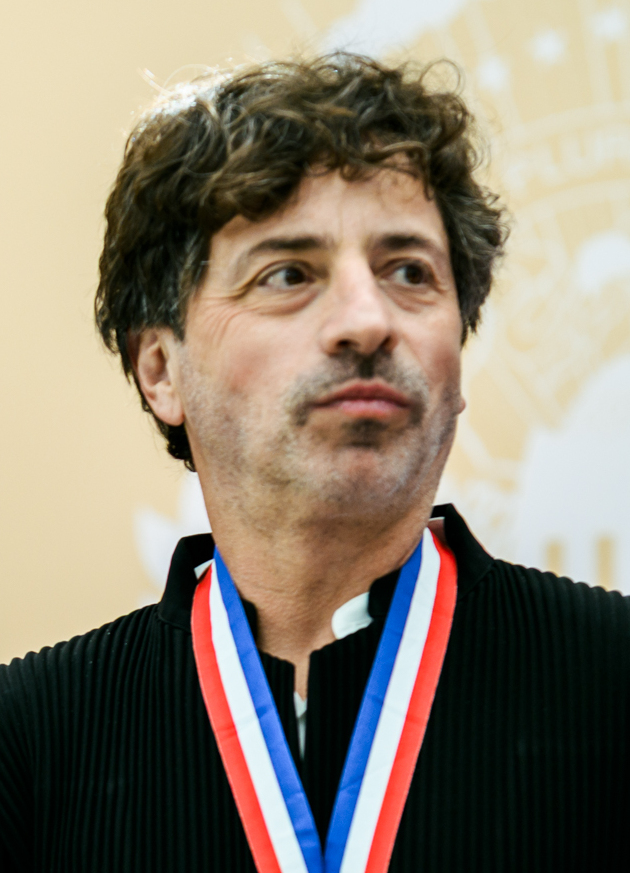
The other co-founder went to a different extreme: he turned his own genome into the experiment.
In 2008 he published a blog post whose title told you everything about the method — LRRK2 and me. A DNA test had come back with the mutation carried by familial cases of Parkinson’s disease. His mother had been diagnosed with the condition a decade earlier. The number he repeated afterwards was roughly 50% lifetime risk, against about 1% for everyone else — not a diagnosis, an actuarial fact about his own skull. Most people who learn that buy a supplement. He reorganised his life around it.
The habits follow the numbers rather than the other way round. He has spoken about eating less and eating carefully, about sleep as an intervention rather than a luxury, and about exercise the way an engineer talks about instrumentation — something you do because it moves the reading. What he has never done is sell the protocol. No Brin stack, no Brin brand, no book.
The money went the same direction as the science. In 2019 his foundation and Michael J. Fox’s launched ASAP — Aligning Science Across Parkinson’s — a collaborative network spread across five continents and, by late 2023, running at roughly $350 million a year. By 2022 Forbes had counted more than $1.1 billion of Brin’s own money into the disease, a figure that has only grown since. The logic isn’t complicated: when your own nervous system is the thing on trial, solving it stops being philanthropy.
He is not, notably, a patient. He is a man who knows his odds and has spent nearly two decades trying to shorten them — which, of the ten people in this series, is the least fashionable approach available and possibly the most rational.
His name is Sergey Brin. He is 53 years old and, at around $214 billion, the fifth-richest person in the world — and the richest man alive who knows his own genetic odds to two decimal places.
Sources & citations
- Brin’s personal blog (Sep 2008) — LRRK2 mutation, ~50% lifetime risk — reported by The Guardian, 19 Sep 2008
- Forbes (Dec 2022) — $1.1B+ donated to Parkinson’s research
- Bloomberg Businessweek (Dec 2023) — Brin and Michael J. Fox, ASAP at ~$350M a year
- Net worth: Forbes Real-Time, Nov 2026
Part 6 of the series “What Billionaires Actually Eat.”